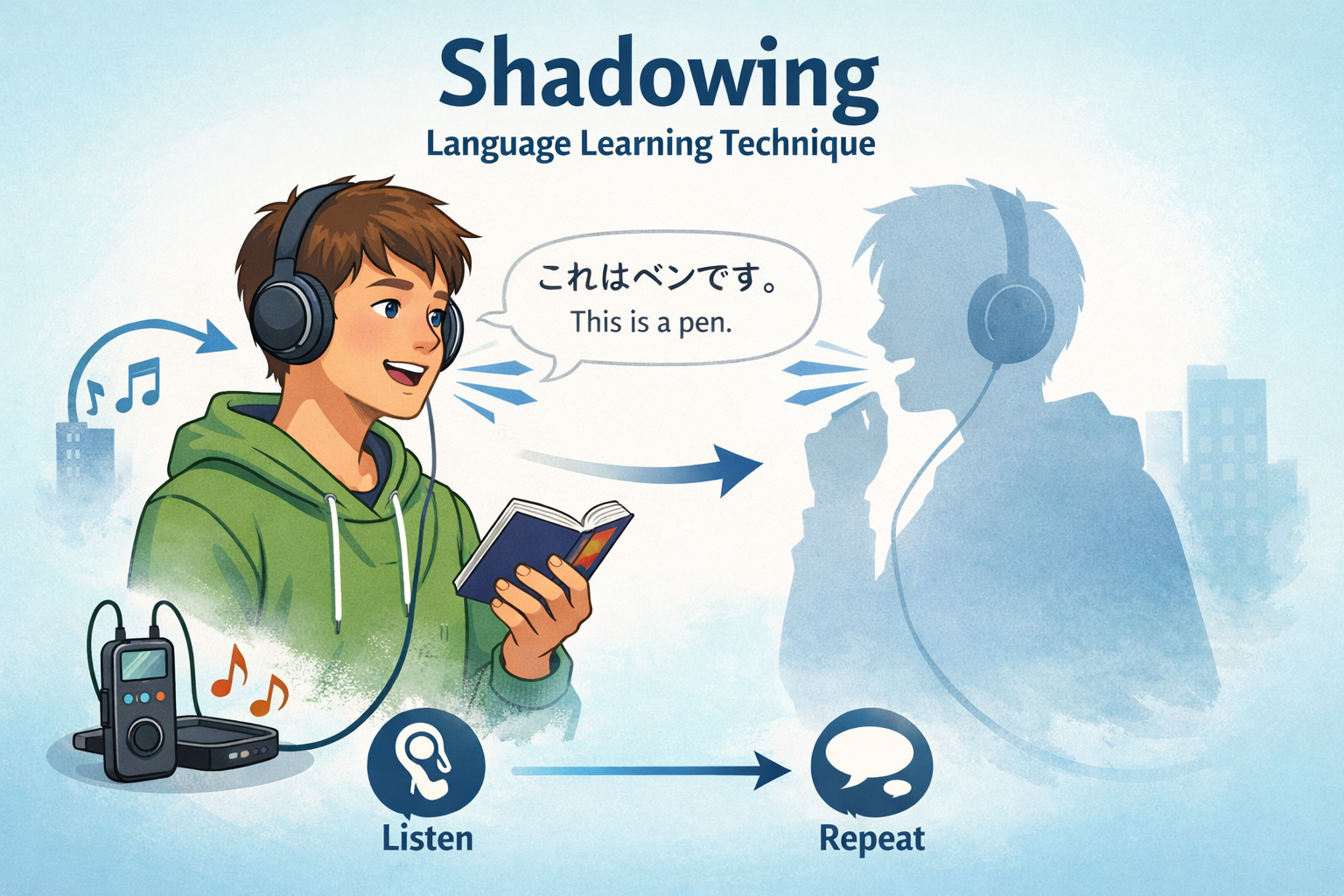
Shadowing in 30 seconds
You listen to a short clip and speak along almost at the same time. That trains ear and mouth together.
The big win: you learn not only words but rhythm, pauses, and natural sentence melody.
In short: shadowing especially helps fast comprehension and fluent speech.
Why shadowing works well
1) You listen more precisely
Many learners hear words but miss small sounds between them. Shadowing sharpens that skill. Research describes this as stronger bottom-up processing (Kadota, 2019; Hamada, 2016).
2) You sound more natural
Because you practise with real audio, you pick up better rhythm and stress—aligned with findings on prosody and fluency in shadowing training (Hamada, 2016).
3) You get faster
You must react in real time. That makes conversation easier and can support speech automatisation (Kadota, 2019; Miyake, 2009).
In short: shadowing trains understanding, timing, and flow at once.
What studies suggest
Work in foreign-language teaching often shows positive effects on listening, prosody, and fluency. Learners with weaker listening profiles often benefit clearly (Tamai, 2005).
For individual problem sounds, results vary by material and measurement—targeted pronunciation work can still help alongside shadowing.
Simple takeaway
If your goal is better understanding and more natural speech, shadowing is one of the most practical methods for daily use.
Many models share the same core: process the sound accurately first, then build meaning and production (Kadota, 2019).
Further reading (selection)
- Tamai (2005): shadowing and listening comprehension.
- Kadota (2007/2012/2019): input–output monitoring, phonological loop, sound-to-meaning.
- Hamada (2016): pronunciation, prosody, listening gains.
- Miyake (2009): articulation speed after shadowing training.
- Recent work (2025–2026): motivation and confidence in learning settings.
Practical protocol for A2–B2
Use short clips (20–60 seconds) and a clear sequence. Staging reduces load and is widely recommended.
- Listen once without speaking
- Shadow with a transcript
- Shadow with a slight delay
- Shadow without text (or minimal support)
- Record once and compare briefly
Plan 10–20 minutes per session. Longer is not automatically better.
Example 1: commute (12 minutes)
Goal: smoother speech on the way to work
- 2 min: listen to clip
- 4 min: shadow with text
- 4 min: shadow without text
- 2 min: one recording + quick check
Example 2: at home (15 minutes)
Goal: understand fast speech better
- 5 min: mark difficult spots
- 6 min: delayed shadowing
- 4 min: live shadowing + recording
Common issues and quick fixes
The clip is too hard
If you drop out after a few seconds, choose shorter, clearer audio. High speed is a common stumbling block in recent studies.
You say words but without rhythm
Schedule one session a week focused only on pauses, sentence stress, and melody.
No visible progress
Record a comparison take every week so progress is real, not just a feeling.
Motivation drops
Set small weekly goals and track wins. Recent studies report gains in confidence and motivation from visible progress.
Shadowing + spaced repetition
Strong combo: shadowing for quality, spaced repetition for long-term memory.
After each session, add 1–2 short “gold segments” (5–10 seconds) to your SRS.
See Spaced repetition with audio for a practical complement.
12-week overview
- Weeks 1–2: onboarding, material choice, baseline recording
- Weeks 3–4: slowly increase live shadowing
- Weeks 5–6: fix recording + review in the routine
- Weeks 7–8: focus on prosody
- Weeks 9–10: transfer to new speakers
- Week 11: move gold segments into SRS
- Week 12: final recording and comparison
FAQ
How often should I shadow?
Prefer 4–6 short sessions per week over one long session.
Do I always need a transcript?
It helps at first. Later, train more often without text.
Does shadowing help pronunciation?
Yes—especially rhythm, timing, and natural sound. For specific problem phonemes, add targeted drills.